



My sister is a civil engineer. I’m a TV producer turned corporate strategist. On paper, we have almost nothing in common professionally.
But a several years ago we were talking about our careers, and she mentioned she was thinking about getting her PMP—her Project Management Professional certification. She suggested I look into it too. And something struck me: two people from opposite industries, eyeing the exact same credential.
That moment changed how I thought about getting out.
For years I’d known entertainment wasn’t sustainable for me. I loved parts of it—the problem-solving, the adrenaline, the creativity. But the hours were brutal, the pay was unstable, and the industry was getting harder to justify staying in. What I didn’t know was what came next. I just knew I wanted out, and I was terrified of choosing wrong.
The PMP became my answer. Not because it pointed me toward one path, but because it proved something. A credential valuable enough to advance my sister’s engineering career could advance mine too, coming from the complete opposite direction. Versatile. Respected. And it didn’t lock me into anything.
A bet on myself without betting everything.
I’d known about it for a couple of years before I actually did anything. It felt like a big, lofty commitment, and I was doing fine—steady work, no urgent pressure. Investing real time and money felt overwhelming when I wasn’t sure what direction I was heading.
Then Covid hit. I was working in live events at the time. My entire career disappeared overnight. No income, no timeline for when work would come back, no safety net.
That’s when the PMP stopped feeling overwhelming and started feeling like the smartest bet I could make. When your career vanishes, you get very thoughtful about money. I couldn’t afford to waste several hundred dollars on something that wouldn’t pay off. But I could afford to invest in something that would open doors instead of closing them.
So I did it. One of the best decisions I’ve ever made.
You’ve Been Doing This Your Whole Career
If you’re a mid-career professional in entertainment—any role that involves leadership, coordination across departments, or keeping a hundred moving pieces from colliding—I’m confident you’d qualify. Because you’ve been doing project management your whole career. You just didn’t call it that.
Line producer, showrunner, production manager, coordinator, anyone running logistics across departments—this is you. And if you’re thinking about a pivot, whether that’s into project management specifically or somewhere else entirely, the PMP travels with you. It’s not a one-way door.
There’s also a clock on this, and for once it’s working in your favor. PMI is changing both the rules and the exam in 2026—and the changes make it easier for someone with your background to qualify, not harder. What’s changing, whether you actually qualify, and exactly how to do it: that’s all below.
My Story: How I Actually Did It
When I decided to go for it, I had rules. I didn’t want to go back to school for a full degree—that meant committing to a path I wasn’t sure about. But I wanted credentials other industries would respect.
So I enrolled in a single project management course at BCIT, where I’d done my broadcast and media communications program years earlier. One semester, part-time, a few hours a week, about $525. It gave me the 35 contact hours I needed to qualify for the exam. I chose it on purpose, because I know how I learn best—and when you’re deciding how to earn your hours, that matters more than people realize.
I started in September 2020 and finished in November. That’s when I found out the exam was changing at the end of the year, moving from a focus on traditional methodologies to incorporating agile. That kicked me into gear.
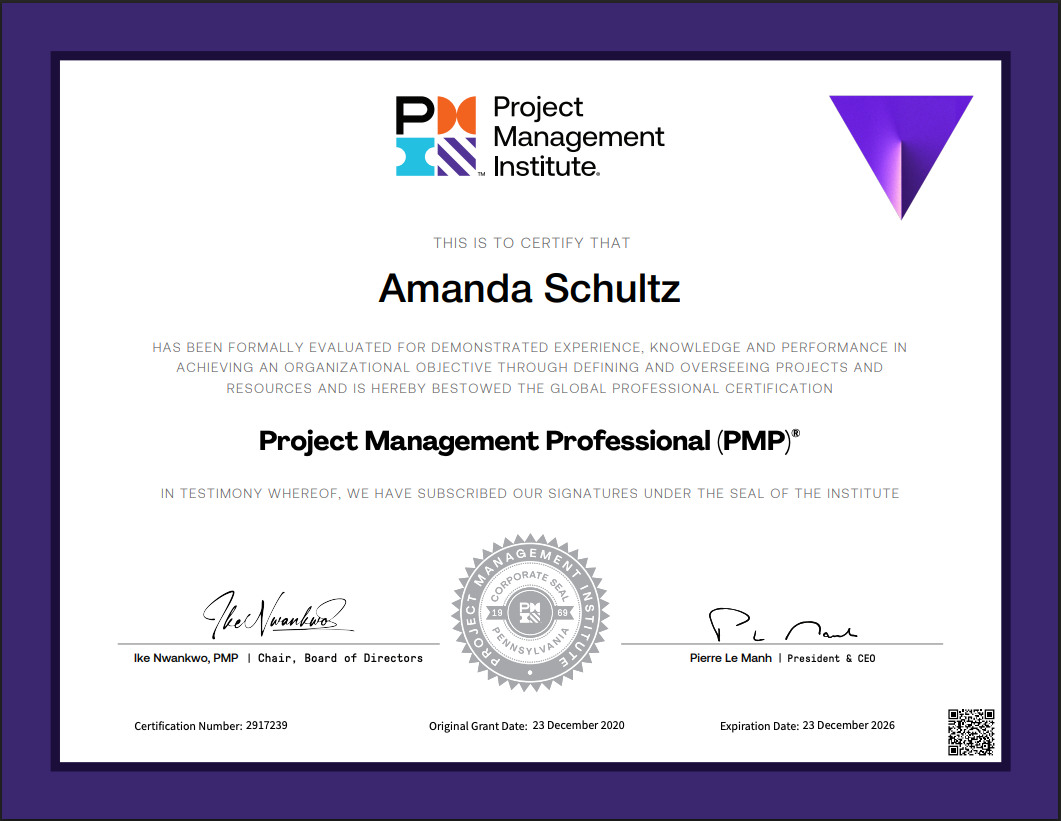
I spent three weeks on intensive prep and treated it like my actual job. The PMP exam is not something you can wing. The questions are wordy and deliberately tricky—they test whether you understand the concepts, not whether you’ve memorized the definitions. I took it on December 23, 2020, giving myself a buffer to retake before the change if I had to.
I passed on the first try.
Three weeks is aggressive. I couldn’t have done it while working live events with unpredictable hours. But the course itself, September to November, I could have managed alongside work. Hard, but doable.
The real value wasn’t the credential. Going through the coursework, I was building a mental map—taking everything I’d done in production and learning to see it through a lens corporate could actually understand and pay for. That translation is what made me marketable. It’s what Scene Change came out of. Because that value isn’t exclusive to people chasing the PMP. It’s what every entertainment professional needs, wherever they’re headed.
What You Should Know
You don’t need a project manager title. You don’t need a business degree. You don’t need to have done any of this in a corporate office. If you’ve managed projects in entertainment—and you have—you can qualify.
The PMP didn’t change my life on its own. But it was a big part of how I worked to change it. If you’re thinking about getting out of entertainment, it can be part of how you change yours.
So let’s get into the “how” and the “why”.
