


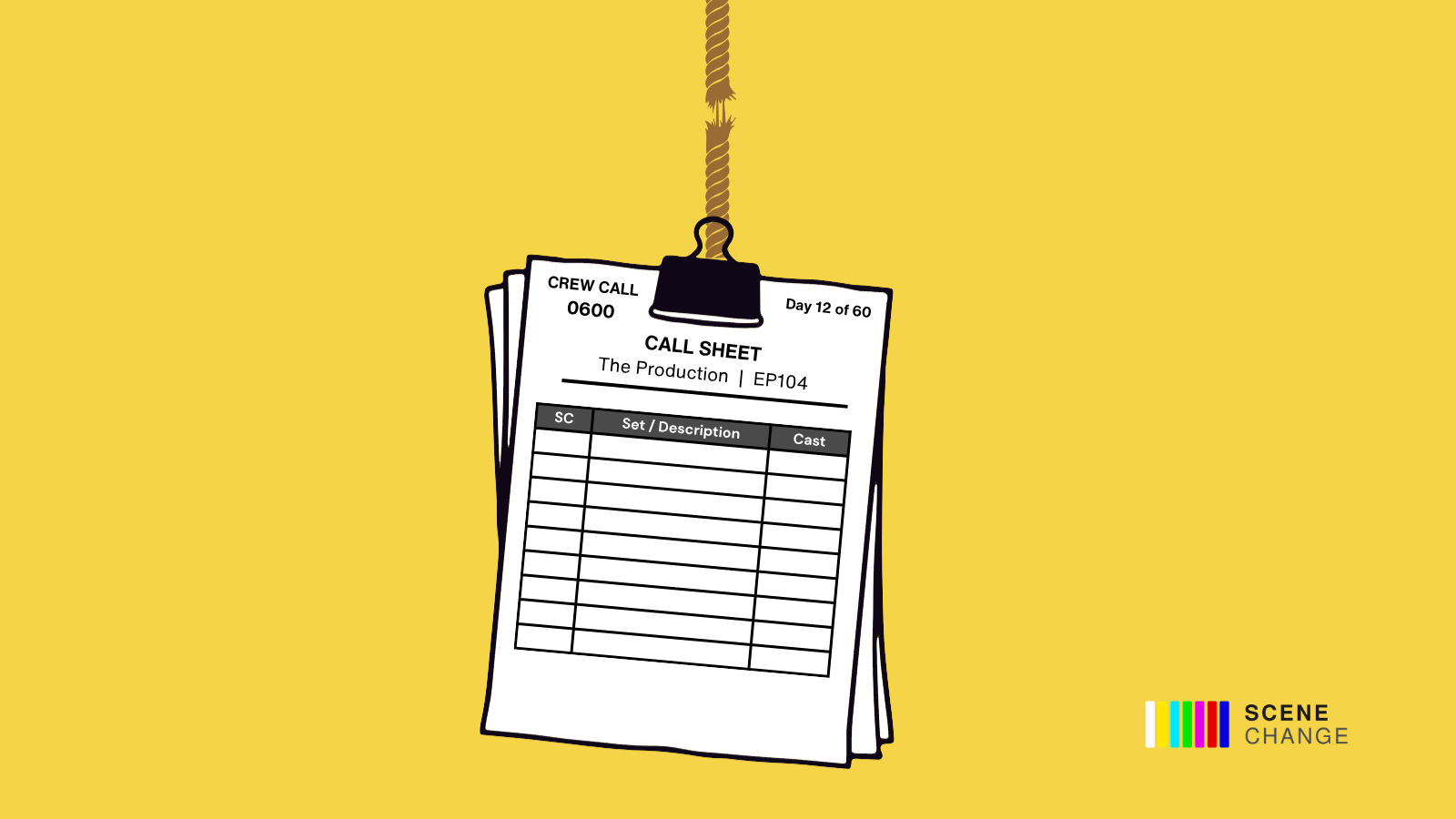
No one reads the call sheet.
It’s a saying in production. The call sheet is the single most important document of any shoot day. Call times, schedule, locations, what you’re shooting, who’s responsible for what, and roughly four hundred other details that all matter at once. It goes out the night before. Almost nobody reads the whole thing. People scan for their own call time and move on.
That’s the standard. The most critical piece of information on set, treated like a menu you’ve already decided on.
Then one night it goes out late—10 PM and it’s still not out for a 6 AM call. Everyone on the production is refreshing their email like they’re trying to get Eras Tour tickets. Then the texts start. Where’s the call sheet? Can you just tell me my call time so I can go to sleep? The thing nobody reads becomes the only thing that matters. And they feel it. Every minute it’s not there.
Both of those things are true at the same time. The call sheet is ignored and the call sheet is everything.
I’m telling you this because I think you recognize this pattern, even if you’ve never made a call sheet in your life.
The better you are at this kind of work, the less anyone notices you’re doing it. A schedule that runs like clockwork looks like it never needed building. A system that works seamlessly looks effortless. A day that goes off without a fire drill looks like there was never a risk of fire to begin with. When your entire job is to make everything run so smoothly that nobody notices it running, you are signing up for invisibility. Do it well and you vanish.
What’s different about doing this work in production versus corporate is that in production, you don’t actually vanish completely. Not in the same way.
In production, you remember the coordinator who managed an absolute disaster of a shoot—everything going wrong at once—and you could see them holding it together. You remember the line producer who made impossible decisions under pressure. You remember white-knuckling it alongside someone, getting to the finish line, and looking them in the eye at wrap saying: I can’t believe that didn’t fall apart. That visceral, shared experience of nearly losing it and not—that’s how you know someone is doing essential work. That’s who you call next time. Your metric isn’t on a dashboard. It’s in your nervous system. It’s the memory of almost failing and someone refusing to let you.
So in production, connective tissue work is invisible when things go smoothly. But it’s not invisible when things catch on fire. And production always has fires. Everyone is close enough to the work to see you holding the rope. They remember.
Then I went to work in corporate. And I walked into the same invisibility problem, except the people who could see the rope and the people who decided whether the rope was load-bearing were no longer the same people.
Let me explain what I mean, and let me do it in production terms first.
Imagine a shoot where leadership decides they don’t need an AD or coordinator. The gaffer, the sound mixer, the production designer, the location manager—they all have the skills, they’re all professionals, so they’ll just each enter their own details into the call sheet and sort the rest out between them. It’ll come together. They’re smart people.
Anyone who has ever made a show is getting nauseous at the thought. You know exactly how that shoot goes. People sent to the wrong location. Two departments waiting on information nobody owns. The first shot happening at noon because no one reconciled crew call with the truck arrival with catering with the location’s hard out. It’s a great way to make a project take twice as long, cost three times as much, and need double the staff to produce something with a sliver of its potential. Nobody would run a production this way, because everybody can feel in their bones that it would be pain. All the way down.
The nausea is telling you that a coordinator or AD isn’t valuable because they’re the only one with the skills to build a call sheet. They’re valuable because their entire job is to hold the view above the silos. The gaffer is optimizing for the gaffer’s day. The sound mixer is optimizing for the sound mixer’s day. Both are right, inside their own box. The coordinator is the only one whose job is the whole system—how every box affects every other box. You cannot split that across the boxes. The moment you do, the view from above disappears, and the view from above was the entire point.
Corporate does exactly this, all the time, and doesn’t wince. The high-priority initiative gets greenlit without a dedicated project manager, because the directors are capable and senior and surely they can hold it together off the side of their desks. So the connective tissue work goes into the margins of leadership. Decision wrangling. Mapping every way it can go wrong and building plan A, B, and C. Tracking dependencies. Keeping information moving. Making sure people have what they need. Two jobs. One of them doesn’t have a name, so one of them doesn’t get counted.
It’s not that corporate has no nervous system response at all. That’s not quite right. The response exists. It’s just trapped at the wrong altitude.
The person doing the connective tissue work feels it. Their manager feels it. Their team feels it. Ask anyone who sits next to a great operator and they’ll tell you the same thing: I couldn’t tell you exactly what they do all day, but the week they’re on vacation, everything is harder. That’s the call sheet going out late. That’s the rope, visible for a second because someone let go of it.
But that feeling never travels up. Two and three levels removed, the people deciding whether the function survives the next reorg don’t sit next to the work. They’ve never felt the vacation week. They see a dashboard. And the dashboard doesn’t measure prevented disasters, decisions that happened on time, or institutional knowledge that didn’t walk out the door. It measures revenue, output, unit cost. So the work that prevents problems—the work whose entire success condition is that nothing happened—is invisible to exactly the people with the authority to cut it.
So they cut it. I watched it happen at a tech company heading into layoffs. The PMO went. Bizops got consolidated. Every director was suddenly doing twice the connective tissue work in the margins while still accountable for hitting their numbers. And nobody connected the slower decisions, the miscommunications, the projects quietly slipping—back to the cut. The infrastructure was already invisible. Now it was just invisible and gone.
Which brings me to the part that took me way too long to learn.
If you do connective tissue work in corporate, the work will not speak for itself. You will have to speak for it. Constantly. You spend energy you don’t have building the case for your own existence—naming the dependencies you caught, documenting the disasters that didn’t happen, translating “I held the rope” into the only language the room speaks: here’s the risk I removed, here’s the decision speed I protected, here’s what breaks and what it costs the day this function is gone.
It is a strange kind of gaslighting. You can feel that the work is essential. The people closest to you can feel it. And the system keeps calmly informing you that it doesn’t quite count, because it can’t quite be measured. You start to wonder if you’re imagining your own value. And you can’t stop doing the work to find out, because you’ve seen what’s on the other side of letting go of the rope.
So you scratch and claw for visibility. Not for ego. For survival. To make sure the people who’ve never felt the vacation week understand enough about what you do that they don’t reorg it, lean it out, or “optimize” it away—and you along with it. Because they will, if they can’t see it. And the consequences will stay diffuse for long enough that no one ever proves it was the cut that did it.
No one reads the call sheet. Right up until the day there isn’t one.
And then, for about an hour, everyone finally understands what it was for.
Then the next one goes out, on time, and they stop reading it again.
This made me think about another layer.
I wonder if the real challenge isn't that people skip details. It's that they're making a fatigue bet.
Most of the time, skimming works. Most details don't change the outcome.
But complex systems are often defined by the exceptions.
AI adds an interesting twist because it can compress information so quickly that speed itself starts to feel like coherence, and coherence starts to feel like understanding.
Maybe the question isn't whether people read the call sheet.
It's whether we've started mistaking a good summary for shared understanding.